Many of us plan our gardens with the intent of attracting our favorite pollinators: bees! But where do our buzzy friends hide when the days get shorter and the frost creeps in? The answer is a little more complicated than you’d think!
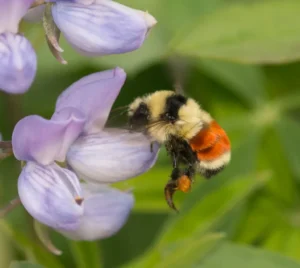
Idaho is home to many species of native bees, all with their special role to play in the environment. For example, Bombus huntii, or Hunt’s bumble bee, is an Idaho native species that in the summer lives in colonies similar to a honeybee. See image below. Image sourced from here
In winter, the reproductive females, or queens, hibernate alone under leaves or in a shallow hole in the ground. The queen will produce an antifreeze to keep the cells in her body from freezing solid during deep freezes. The males and workers complete their life cycle at the end of the season. Each queen will emerge in the spring to feed on early season flower nectar. She will begin the search for a suitable nest site such as an old burrow or within a pile of logs. She then begins the process of provisioning the nest with pollen balls on which she lays her eggs. She will also create a honeypot and fill it with nectar to feed herself once she becomes nest-bound laying eggs. The females who are hatched from this first round of eggs will then forage for nectar and pollen and continue building the nest while the queen stays underground and lays eggs. At the end of the season the queen will die and the new queens from the colony will start the process over again.
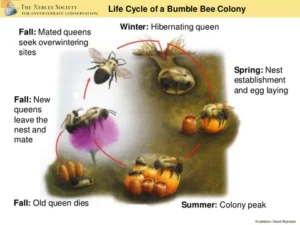
Image: David Wysotski / Allure Illustration https://xerces.org/bumble-bees/about
Most of us think of bees as living in hives or colonies like the Hunt’s bumble bee, but a large majority of them are actually solitary. And most nest under ground. The Idaho native Bombus morrisoni, or Morrison’s bumble bee, is a solitary bee that nests in both areas above and below ground. Other species of bees may hibernate in leaf litter or in hollow plant stems. Hylaeus lunicraterius is a yellow-faced bee endemic to Idaho, and it nests in rock cavities at Craters of the Moon!
To learn more about the bees and other insects common to our area check out this great guide from the Harris Ranch Wildlife Mitigation Association A Field Guide to Common Insects of the Treasure Valley
So you might be wondering… What can I do for the hibernating bees in my garden? I am the first to jump at starting my fall clean-up, as I love keeping things neat and tidy. However, in order to keep your pollinator garden a place where the bees want to sleep, we have to be comfortable with leaving a little mess behind for them.
When doing your fall cleanup in your native garden, use extra precaution or skip it altogether depending on how many trees you have in the yard. Resist the urge to mow the leaves into small pieces which can shred insect larvae. If you must, lightly rake leaves out of the native perennial beds leaving a light layer.
Wait as long as you can to tackle spring garden chores. Give the bees a chance to wake up from winter before digging around in or cutting into their homes. Bees and other pollinators will use dried and hollow stems to safely keep their larva. See photo for reference. While the sun may be out and plants may be starting to flower, the soils warm slowly and may not be warm enough to trigger the bees to emerge.
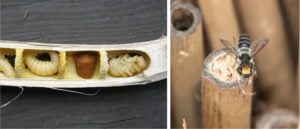
When dealing with areas of bare ground in the yard. Avoid digging in the soil in areas where nest entrances are spotted. Sometimes the entrance to an underground nest can be tricky to spot. When you are in your garden be watchful and see if you can spot a bee entering her nest and make a mental note to avoid the spot.
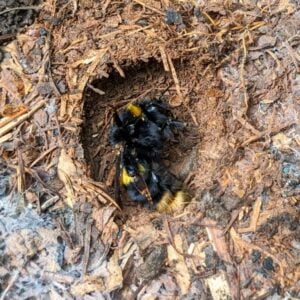
If you have a lawn or a large amount of leaves, clean up some of the leaves and evenly distribute the rest to form a light covering. If you are looking to kill your lawn then by all means leave a very thick layer of leaves. If not, just leave a light layer and use the rest in your compost bin, leaf mould bin, or on top of your vegetable garden beds.
Leave some leaves in the garden beds, but make sure your plants aren’t suffocating with a thick layer near the plant bases! Native plants are not used to all the organic matter that comes with our tree canopies and the stems can rot if too many leaves are decomposing against their stems.
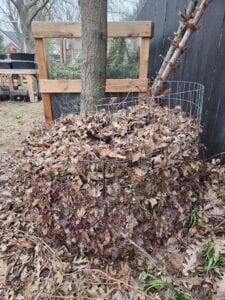
Take advantage of the free organic matter your yard produces. And provide a safe place for bees at the same time. You can easily make a leaf mould bin to contain the extra leaves on your property. Just take a section of 3 or 4 ft metal fencing from the hardware store, loop it into a circle, and toss in your leaves! That way all the priceless organic matter that your trees created can stay on site and be reused to make your vegetable or perennial gardens more productive. After about a year the leaf mould will be nicely decomposed and you can place it in your planting beds. In the meantime, it could be a fantastic bee wintering hotel.